




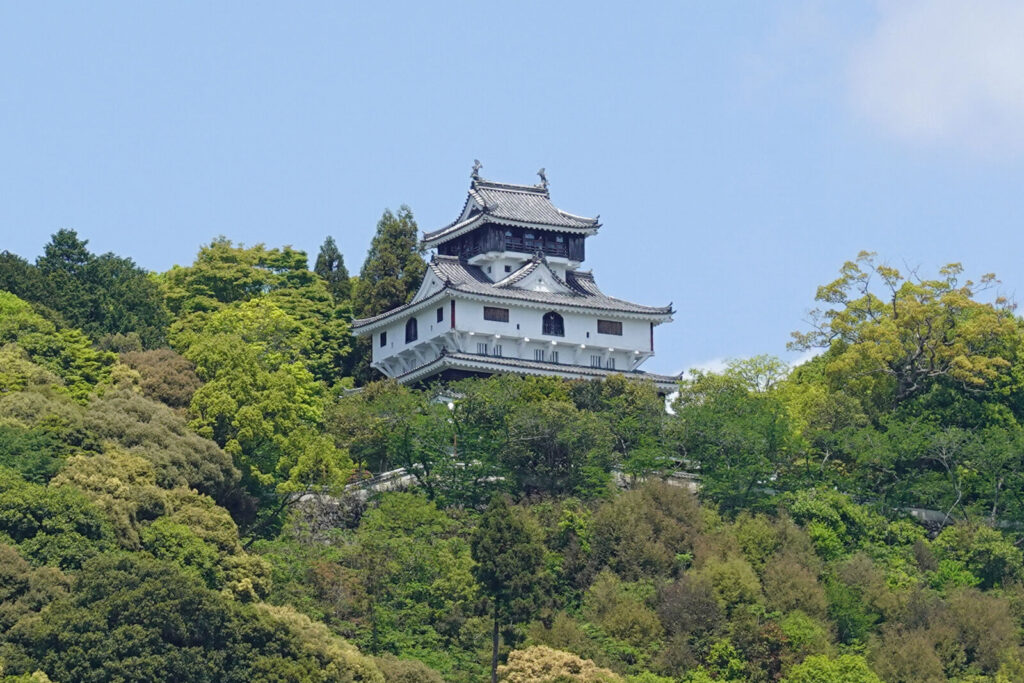
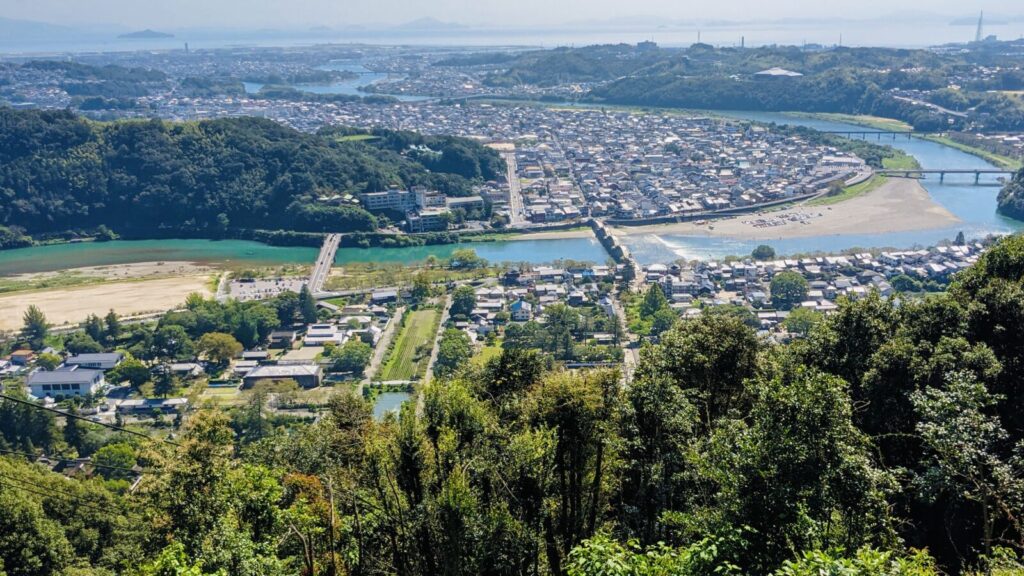
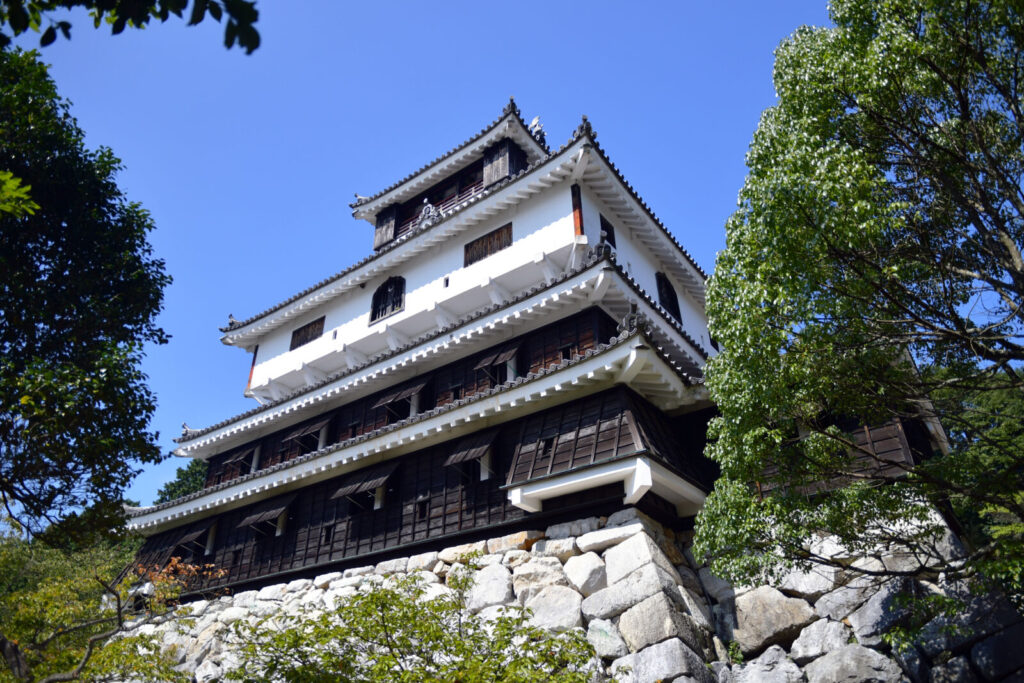
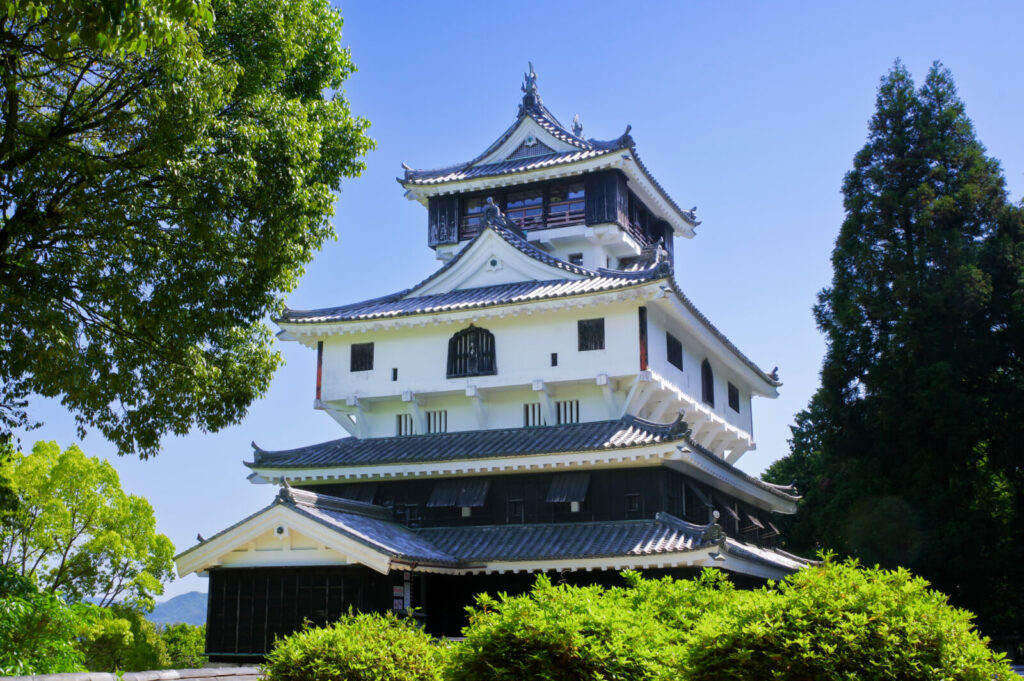
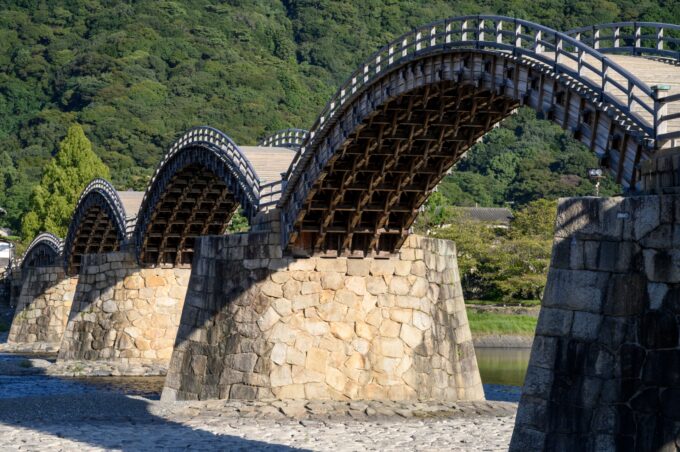
Iwakuni Castle is a four-storied building which stands at the top of Mount Shiroyama in the city of Iwakuni. The inside of the castle serves as a museum which tells the history of Iwakuni and its ruling family, the Kikkawa Clan. Historic artifacts and weaponry are also displayed throughout the different floors. At the very top of the castle, one can enjoy a breathtaking view of Iwakuni’s landscape, which includes the distinguished Kintaikyo Bridge and beautiful Nishiki River.
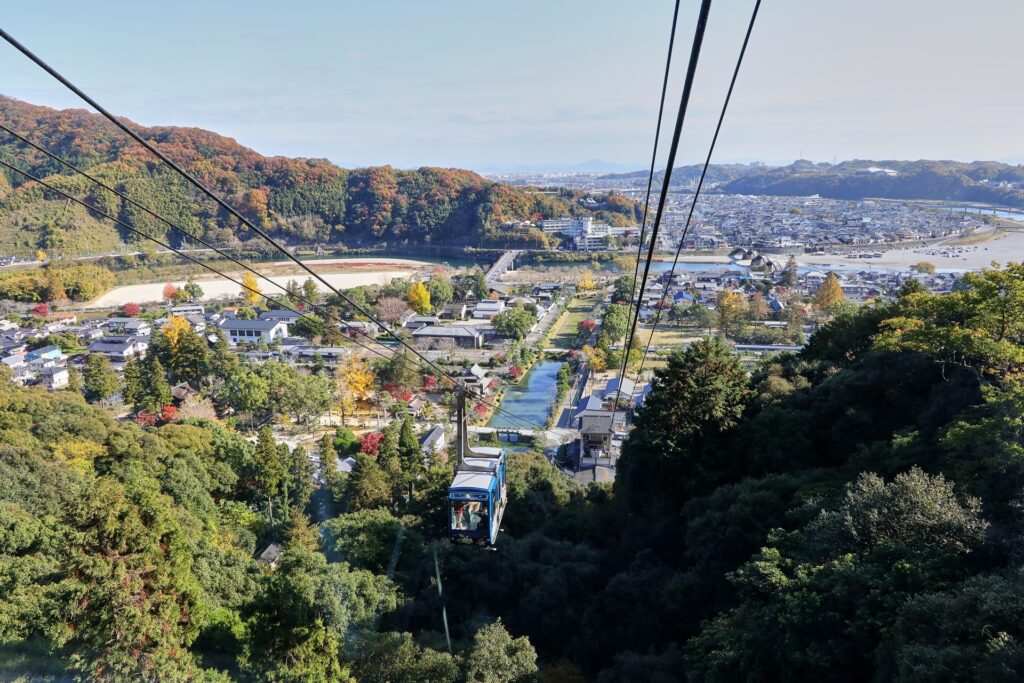
The Castle can be accessed via a short 3-minute ropeway ride, followed by a 10-minute walk. A combined ticket for the Kintaikyo Bridge, Ropeway, and Iwakuni Castle can be purchased at the ticket booth in front of the bridge, and we recommend doing so due to its convenience and cheaper price. The adult ticket costs JPY970 and the child ticket costs JPY460.
While Iwakuni Castle is not as famous as the Kintaikyo Bridge lying before it, the castle does have an interesting history dating back to the early 17th century. The scenic views it offers are also particularly stunning and definitely make it a location worth visiting.
Where is Iwakuni Castle?
The castle is located in the city of Iwakuni in Yamaguchi Prefecture. It is part of the “Iwakuni castle town area” which includes the Kintaikyo Bridge, Kikko Park, the castle itself, and other historic buildings. From the JR Iwakuni Station, visitors need to take a bus or taxi to Kintaikyo Bridge, which must be crossed on foot to access the castle town.
As Iwakuni Castle is located at the top of a mountain, you must board a ropeway to access it. Of course, it is possible to hike to the top, but we recommend using the ropeway as it is faster and safer. Once you reach the summit, the castle is a short walk away from the ropeway station.
History of the Castle
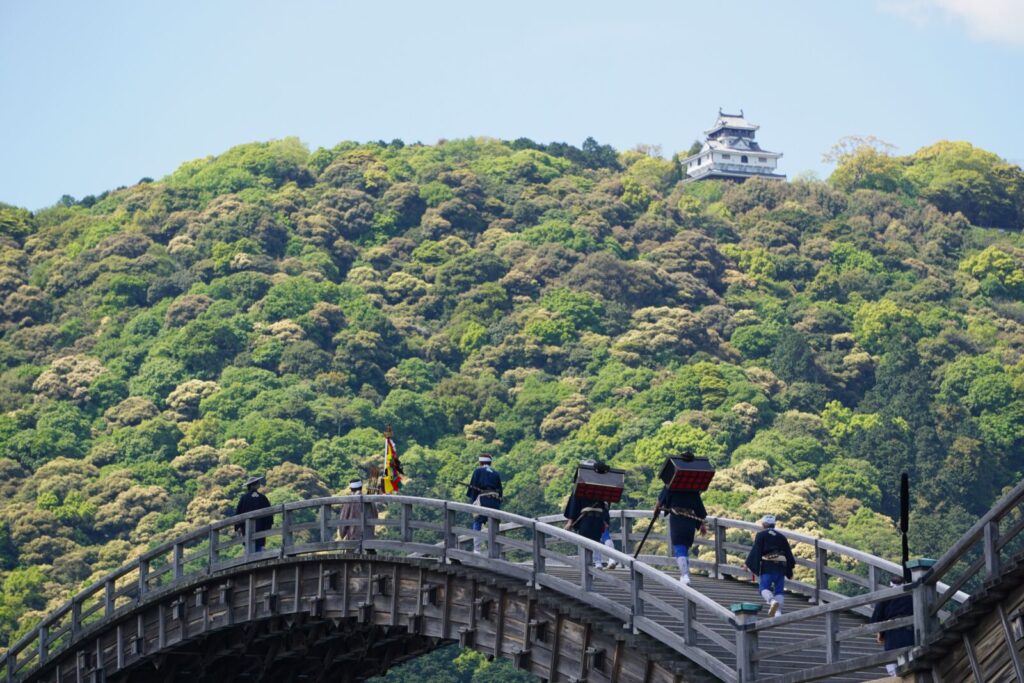
Construction of Iwakuni Castle began in 1603 under the direction of lord Hiroie Kikkawa. The Kikkawa clan had just been awarded a part of Iwakuni’s territory as a reward for their actions during a decisive battle of Japan’s Sengoku period (“warring states period”). To select the site for the new castle, several factors were considered. At the time, Iwakuni had a limited amount of flat land and there was also a risk of another major battle breaking out given the turbulent civil wars period which had just ended. Thus, the top of Mount Shiroyama was chosen as the place to build the castle. This decision was also aided by the fact that the rocks being used to build the castle came from a quarry with a similar elevation to mountain, making their transportation easier.
Due to some interruptions and delays along the way, the castle was not finished till 1608 and unfortunately it would not be around for very long. In 1615 a law was passed by the Shogunate, the military government, which only allowed one castle per province. One castle would be chosen as the only one allowed to remain, while all others would have to be destroyed. Iwakuni castle was one of the latter, and thus, just seven years after its construction, the castle was torn down. The Kikkawa family continued to rule over Iwakuni from their private residence by the foot of the mountain, but the castle was never rebuilt during their time.
The present day Iwakuni Castle is a reconstruction from 1962, thus this replica has been around for longer than the original. The location of the castle was even moved when creating this copy, as the original one did not allow for the castle to be seen at the mountain top. To make it visible from the ground, the position of the castle was shifted about 50 meters to the south.
Castle Layout
In the past, the castle consisted of four sections: the main compound, the kitanomaru (“north compound”), the ninomaru (“second compound”), and the mizunotekuruwa (water drawing compound). Additionally, there was a dry moat which separated the main compound and kitanomaru. This type of moat is not particularly common in Japan, and is about 19.6 meters wide and 10 meters deep, making it the largest of its kind in the country.
Tours Visiting Iwakuni Castle
For travelers interested in visiting Iwakuni Castle, crossing the Kintaikyo Bridge, and exploring the general castle town area, we have designed two tours which include all of these activities plus their own unique twist. Our full-day tour of Iwakuni adds a seal engraving experience for cultural immersion, while the Miyajima & Iwakuni tour allows visitors to also explore the island of Miyajima, one of Japan’s top three scenic locations.
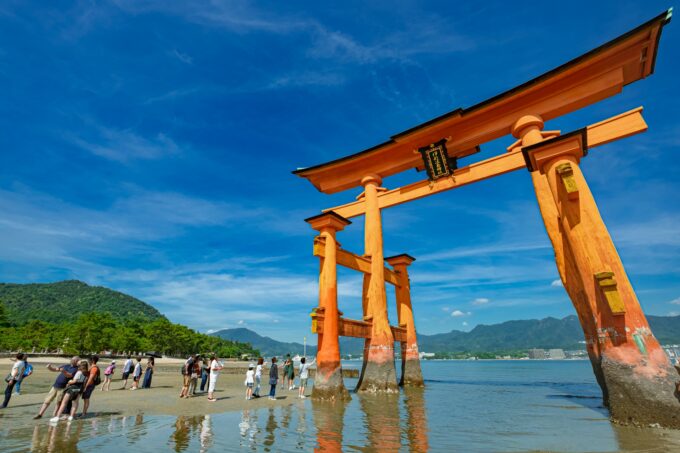
Due to Iwakuni’s proximity to the city of Hiroshima, a more well-known and frequented area, these two tours are designed to start and end in Hiroshima Station. Of course, if you happen to be staying in Iwakuni, you can join the tour from the JR Iwakuni Station.
Hiroshima is usually the furthest west that most foreigners will visit in Japan, but with these tours you can take the opportunity to venture a bit further out and enjoy some of the country’s lesser known sightseeing spots.